
KDOC Barton Release Outcomes
KDOC is a statewide custody and supervision system, not a prison located in Barton County. No KDOC institution was found inside the county. A Barton jail entry that says “transferred to KDOC” records the end of county control and the start of the state path. KASPER then becomes the main public status source.
An Inmate status means state confinement. Parole ordinarily means release from prison under KDOC supervision. Discharged is stronger evidence that KDOC custody and supervision ended. Community Corr. describes a judicial community-corrections category, which should be confirmed with Central Kansas Community Corrections because the state display has a known data limit. Absconder means supervision is being avoided or whereabouts are unknown. It is not a new conviction.
| KASPER status | Release meaning |
|---|---|
| Inmate | Still within state confinement |
| Parole | Released from prison with state supervision |
| Discharged | KDOC involvement has ended more fully |
| Community Corr. | Judicial community-corrections supervision |
| Absconder | Unknown whereabouts or supervision avoidance |
Confirm KDOC Barton Releases
Open KASPER and accept the disclaimer. A KDOC number is the best starting key. Without it, use the name, aliases, birth information, KBI number, or other fields to distinguish the correct person. Barton under Conviction County narrows state cases originating there. Barton under Parole Supervision County finds state-supervised people tied to the county.
- Search the exact KDOC number when available.
- Otherwise combine the name with identity fields and aliases.
- Read the exact status and each date label without treating them as interchangeable.
- Use the sentence and custody events to connect the record to the Barton case.
- Confirm parole through the current KDOC field-office directory or request a specific discharge record.
KASPER updates each working day. A weekend change can lag. A historic discharge event is stronger evidence of what happened than a future estimate. The Barton released-inmate record process remains the right route for a local bond-out that never entered KDOC.
KDOC Release Record Requests
KASPER supplies the public starting record. For more detail, submit a focused Kansas Open Records Act request to KDOC with the KDOC number, the Barton case, the event date, and the exact release or discharge fields sought. K.S.A. 75-5221 governs disclosure and restrictions for correctional records.
The sentencing court explains the term imposed and later court changes. KDOC owns its sentence computation, earned or forfeited credits, custody events, supervision, and discharge record. If those sources appear to conflict, record the discrepancy and ask the responsible custodian to correct or explain it.
KASPER Barton Search Fields
KASPER supports last, first, and middle name; alias searching; KDOC number; photo display; and advanced fields such as KBI number, race, gender, birth date, age range, conviction county, parole-supervision county, community-corrections location, facility, and Supervision Type. Photos help resolve identity but are KDOC images, not necessarily Barton booking photos.
The KASPER form and disclaimer pictured below show the live statewide route.
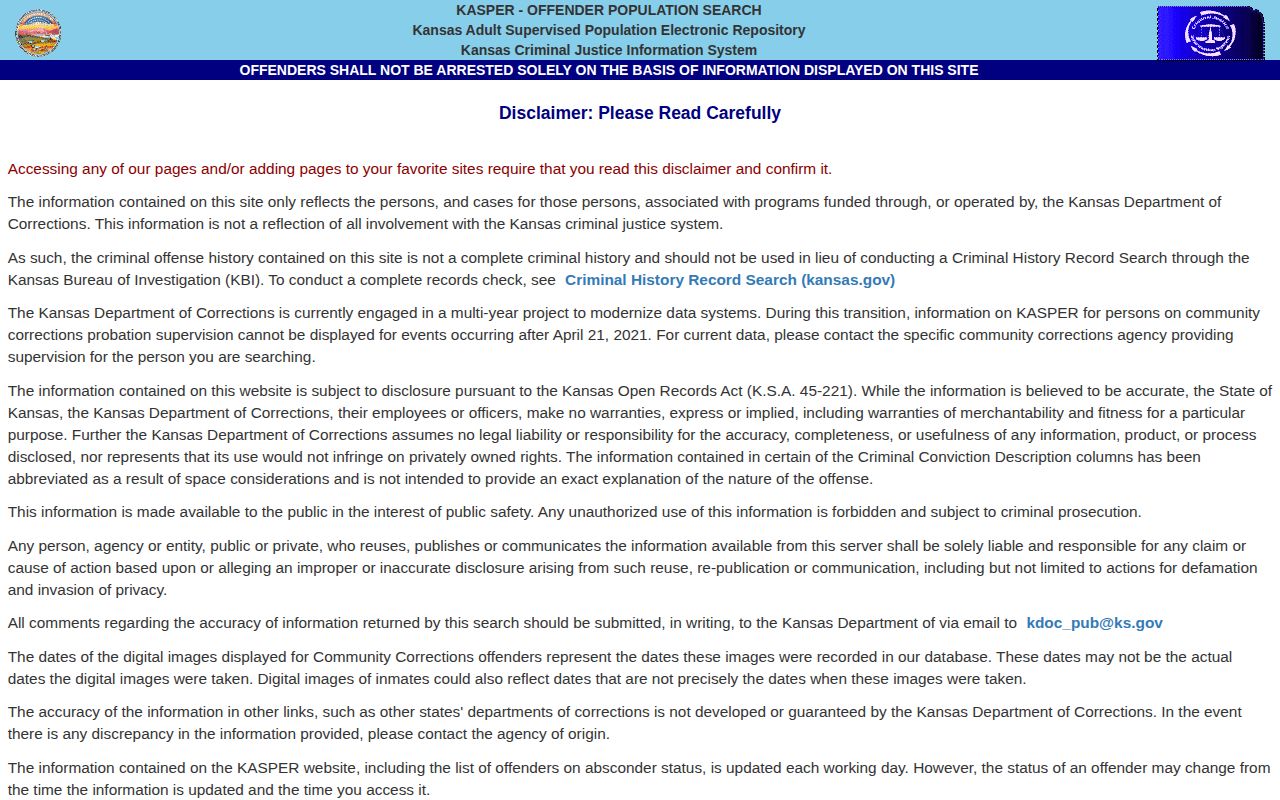
The Barton filters identify conviction or supervision ties. They do not turn the repository into a full county arrest database.
KDOC Projected Release Limits
The research did not confirm a current public KASPER detail label for a projected or tentative release date. Do not invent one. Copy any date exactly as the live record labels it. A future date can change through sentence computation, earned or forfeited good time, court amendments, disciplinary action, detainers, and release planning.
Kansas’s common “85 percent” shorthand is not universal. K.S.A. 21-6821 generally permits up to a 15 percent reduction for post-1993 prison portions, while specified lower-severity and date categories may allow up to 20 percent. Older crimes follow distinct parole and conditional-release rules. Never apply the state formula to a Barton jail sentence.
Barton Parole and Discharge
A Parole status is not discharge. It shows community release with continuing state control. Use the KDOC field-office directory for the current supervision office. A Discharged status more strongly shows completion. Central Kansas Community Corrections is separate from KDOC parole and serves a five-county judicial district from Great Bend.
KASPER warns that community-corrections probation events after April 21, 2021 may not display during modernization. When the sentence assigns CKCC, confirm through that office and the court instead of relying on an old state event.
Read KDOC Release Dates Carefully
Sentence start, parole eligibility, conditional release, projected release, postrelease start, and discharge dates describe different events. Copy each date with its exact interface label and the date the record was accessed. A future estimate may move, while a past event can still be corrected. If KASPER does not display the sought field, ask KDOC rather than calculating it from the sentence alone.
A reliable sentence review begins with the judgment. Identify the crime date, severity or off-grid classification, prison term, consecutive or concurrent structure, jail credit, and postrelease term. Then apply only the credit law that fits. Earned and forfeited credits, disciplinary changes, amended court orders, detainers, and release planning can alter the path. County jail credit is part of that calculation but does not make the Barton jail the owner of the state release date.
Pre-July 1993 offenses use a distinct parole and conditional-release framework. Later guidelines sentences commonly move from the prison portion into mandatory postrelease supervision. Special offenses and mandatory minimums add further branches. No single percentage produces a guaranteed date for every Kansas sentence.
Verify a KDOC Discharge
Start with the correct KASPER identity and KDOC number. Record the exact Discharged status and any visible discharge event. Compare that event with the sentencing history. If a certified or more detailed record is needed, ask KDOC for the public release or discharge fields tied to that number and date.
The court and KDOC answer different questions. The court establishes the sentence and later judicial orders. KDOC establishes its custody events, calculation, supervision, and completion. A Barton news log or county release sheet may document an earlier transfer to state custody, but it cannot prove the later state discharge.
KASPER’s disclaimer provides a correction email for apparent repository errors. Supply the source document that supports a correction and describe the exact field. An urgent custody question belongs with the facility or supervising office because the repository updates on working days rather than in real time.
KDOC Notification After Transfer
Kansas VINE covers Barton County jail custody but expressly excludes KDOC prisoners. Once a Barton record documents transfer to KDOC, stop waiting for a county VINE result to reflect state events. KASPER becomes the public status tool, and KDOC Victim Services provides a separate notification route for qualifying people in a KDOC facility or under KDOC supervision.
KDOC Victim Services lists 1-866-404-6732 and VictimWitness@doc.ks.gov. Its service does not cover ordinary county jail custody, probation, or community corrections without KDOC involvement. The handoff between systems follows custody, so the release sheet’s destination is the key routing fact.
KASPER Identity and Scope Checks
KASPER belongs to the KDOC population, so first confirm that the Barton case actually reached state custody, parole, postrelease supervision, or a KDOC-funded program. A county bond-out, short local sentence, or municipal release may never produce a KASPER record. Absence from the repository cannot cancel a documented Barton booking or prove that no local release occurred.
Use the KDOC number whenever it is known. A name search should be tested against aliases and lawful identity fields such as birth date, age, gender, KBI number, or race. Those fields resolve a candidate; they do not justify a match by themselves. The photo option can help separate people with similar names, but the image is a KDOC record image and may not be the photograph taken during the Barton booking.
County filters also require care. Barton as Conviction County means the state case originated there. Barton as Parole Supervision County describes a supervision connection. Central Kansas as a community-corrections location points toward a judicial program with a known display cutoff. None of those settings proves that the person's last physical bed was inside the Barton County Detention Facility.
KDOC Events That Need a Second Record
A KASPER status is strongest when read with the event history and the sentencing case. Inmate identifies state confinement. Parole identifies release from prison with continuing KDOC control. Discharged is stronger evidence that the state obligation ended. Community Corr. belongs to a judicial community-corrections path. Absconder describes unknown whereabouts or supervision avoidance and does not establish a new offense.
Copy each status and date exactly, including its label and the day the page was accessed. KASPER updates on working days, so a late Friday or weekend event may not appear at once. A current record can also be corrected later. When an apparent error matters, preserve the supporting court or agency document and use KDOC's repository correction channel. Direct an urgent custody question to the facility or supervising office rather than waiting for the public database.
For a detailed discharge record, give KDOC the number, event date, Barton case, and exact fields requested. The court can verify the pronounced term, jail credit, and later judicial changes. KDOC verifies its computation, custody history, parole or postrelease period, and completion. Keeping those roles separate makes a disagreement easier to document and correct.