
Barton County VINE Coverage
Kansas VINE is a free, confidential, voluntary public service for people housed in participating county jails. Barton County appears on the state implementation map. The service can support a one-time custody check and an ongoing alert. It is not the Barton Sheriff’s own roster, and the sheriff publishes no separate current roster or rolling release database.
The state boundary is unusually sharp: Kansas VINE expressly excludes KDOC prisoners. That means a Barton County release or transfer entry naming KDOC should prompt a switch to KASPER. Continuing to search the county-jail feed cannot make a state prisoner appear. Federal BOP or U.S. Marshals custody also requires federal records, and ICE uses its own locator.
VINE reports custody changes, not full case outcomes. A release label may reflect bond, dismissal, time served, a court or prosecutor action, or transfer. Sheriff Records holds the actual time, date, and authority for Barton County jail release. The court file explains the legal order. Those records corroborate the alert.
Search Barton County VINE
Begin with enough identity detail to separate same-name records. Full legal name, spelling variants, age or birth information when lawfully known, and the expected facility can help. A name match alone is not identity proof. VINE is most useful when the person is believed to be in, or recently moved from, Barton County jail custody.
- Open VINELink and select Kansas.
- Choose the offender or custody search and enter the person’s name plus available identifiers.
- Compare matching records by identifiers and facility. Do not assume the first name result is correct.
- Open the matching record and note the status, facility, event, and access date exactly as displayed.
- If no match appears, retry a careful spelling variant, then change systems based on the known custody path.
If the person cannot be found, call Kansas VINE at 1-866-574-8463. This number is corroborated by the current state brochure and other current materials. TTY service is 1-866-847-1298. One Attorney General HTML line prints a conflicting digit, so the consistently documented 8463 number is the sound public choice.
The current VINELink interface is shown in the successful project capture.
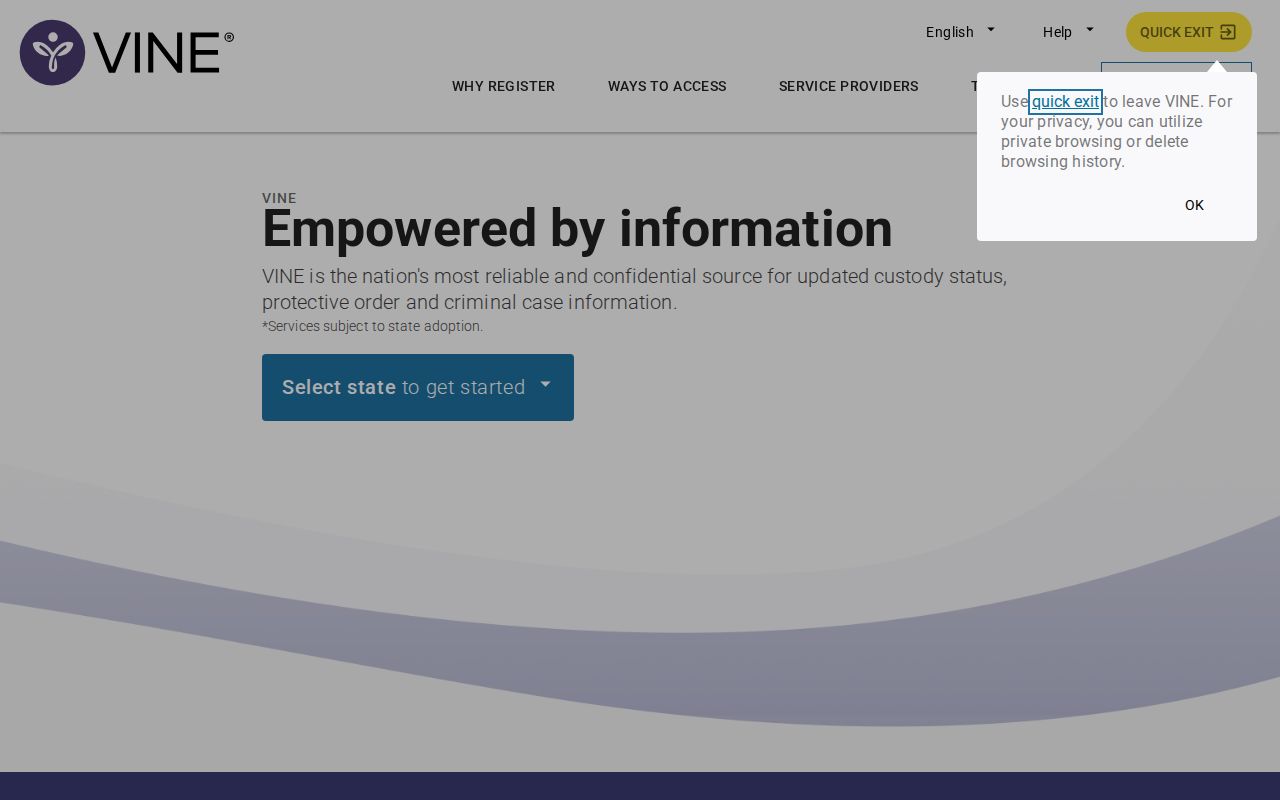
The interface demonstrates why jurisdiction selection comes before a person search or notification registration.
Barton VINE Release Fields
Vendor screens can change, so record what the live result shows instead of promising a fixed set of fields. The research confirms Kansas selection, individual search, available identifiers, a matching custody record, custody status or facility, and notification registration. A released result should be saved with its event date and then corroborated. The event can prove a reported custody change without stating the legal reason.
| VINE item | How to read it |
|---|---|
| Person and identifiers | Use them to distinguish same-name matches |
| Facility | Shows the reporting county-jail source |
| Custody status | Reflects the feed at the access time |
| Release event | Signals departure but may omit bond or court reason |
| Transfer event | May require a different locator for the receiving agency |
| Notification options | Channels currently offered for that active record |
Release, transfer, and escape are different events. Preserve the exact word. If VINE says transfer to KDOC, use KASPER and the KDOC number when known. If it says release, obtain the Barton County release sheet and check the relevant District or municipal case. The Barton County released-inmate record process covers that reconciliation.
Important: VINE can lag and should not be the only source for urgent safety or legal decisions. Verify with the reporting agency.
Register Barton County VINE Alerts
Registration begins from a matching active custody record. This protects against alerts tied to the wrong person. Choose only the channels the current interface offers, which may include telephone, text, email, or an in-app option. Enter the destination accurately and keep it current. Registration is for future custody changes, while a one-time search records the status at that moment.
- Open the correctly matched active Barton County custody record.
- Select the notification or registration option shown by VINELink.
- Choose telephone, text, email, or in-app delivery where available.
- For telephone alerts, create a four-digit PIN and keep it private.
- When an automated call arrives, enter the PIN followed by the pound key to acknowledge it and stop repeat calls.
- Follow the current on-screen confirmation process for text, email, or app alerts.
The phone PIN is not an inmate number and should never be published. It is an acknowledgment code. Email does not use that PIN. An older fact sheet described jail-data refreshes at about fifteen-minute intervals, but that system description is not a promise that a Barton County change will appear within an exact period.
A release alert is concise by design. It may not identify bond terms, dismissal, sentence completion, or the receiving agency. Save the message, note its time, and verify through Sheriff Records or court. Contact law enforcement or the custodian directly for an urgent situation.
VINE-to-KDOC Barton Handoff
Kansas uses separate notification systems for county-jail and state-corrections populations. Once a Barton County detainee transfers to KDOC, Kansas VINE is no longer the right feed. KASPER becomes the public status search. KDOC Victim Services offers separate registration for a person in a KDOC facility or under KDOC supervision.
The KDOC Victim Services registration expressly excludes ordinary county jail, probation, and community corrections without KDOC supervision. Its contact number is 1-866-404-6732, and its published email is VictimWitness@doc.ks.gov. This is a parallel system, not a duplicate of VINE. K.S.A. 22-3727 governs qualifying KDOC release notices.
The handoff prevents a common search error. A missing VINE result after a documented KDOC transfer does not imply release. It means the county-jail-only feed is outside scope. Search KASPER, use KDOC notification when eligible, and keep the court case for the underlying sentence.
Confirm Barton County VINE Events
When no matching record appears, first check spelling and identifiers. Then review the known custody route. A transfer to KDOC calls for KASPER. Federal sentenced custody calls for the BOP locator. Federal pretrial custody may require the District of Kansas docket and facility because the U.S. Marshals Service has no public historical released-person locator. ICE custody uses the ICE detainee locator.
For a Barton County event, the strongest confirmation pairs independent records. VINE shows the reported change. Sheriff Records can provide the booking and release record, disposition sheet, and actual release authority. The District Court or named municipal court explains whether bond, dismissal, sentence completion, or another order applied. A local news log can help locate the date, but it remains a secondary source.
Absence never proves release. The record may use a different spelling, fall outside VINE’s county-jail scope, await an update, involve a juvenile or protected matter, or have moved to another system. A careful VINE inmate check records what was found, when it was found, and which official custodian supplied the confirmation.
Barton VINE Record Keeping
Keep a verification note when a VINE event matters. Record the searched name, identifiers used to distinguish the match, reporting facility, exact status or event label, event date if shown, and access time. Do not record or share a notification PIN. A saved alert is evidence of what the automated feed displayed, not a substitute for the sheriff’s release authority or the court disposition.
If the event is recent, account for system timing while contacting the custodian directly when urgency requires it. A weekend custody change may reach another database on a different cycle. Recheck the correct system rather than searching every database as if each covered the same population. Barton VINE, KASPER, BOP, and ICE records have distinct scopes.
Corrections should come from the source. For a mistaken Barton County jail event, contact Sheriff Records. For a KASPER issue after a KDOC transfer, use the correction contact published with that repository. If a court order differs from the custody feed, preserve the discrepancy and ask each custodian to clarify its own record.
Barton VINE Missing Results
A missing record calls for a scope check, not a release conclusion. First retry the legal name with a careful spelling variant and compare lawful identifiers. Then ask whether the person could have transferred. A Barton County jail transfer to KDOC moves the public search to KASPER. Federal sentenced custody moves it to the BOP locator. Federal pretrial custody may require the District of Kansas docket and the holding facility because the U.S. Marshals Service offers no matching historical release locator. ICE custody uses the ICE detainee system.
Timing can also explain an absence or stale status. VINE is automated, and a county feed can trail the operational event. The older Kansas description of frequent refreshes does not guarantee a precise Barton County posting time. Call the corroborated VINE service number for search help, but call the Barton County Sheriff when a direct and urgent custody confirmation is required. The agency, not the notification vendor, controls the underlying release record.
Protected or nonpublic circumstances may limit what appears. Juvenile matters, sealed records, spelling differences, and records outside the system’s population can all affect search results. Record the query and access time without declaring that no result means the person is free.
Barton Release Alert Follow-Up
After an alert, identify the event before choosing the next office. A county release should be checked against the Sheriff Records release or disposition sheet. A transfer requires the receiving agency’s locator. The relevant court record can distinguish bond, dismissal, sentence completion, and another judicial action. That distinction matters because “released” describes the end of Barton jail control, not necessarily the end of all custody or legal supervision.
For a KDOC handoff, search by KDOC number when available and read the exact KASPER status. “Inmate” indicates current state correctional custody. “Parole” indicates community release under state control. “Discharged” is stronger evidence that KDOC control ended. KASPER updates each working day, so the event and public status may not change at the same moment.